

News
To Fall Through or Not to Fall Through: The Pandemic Effect
| The market is very buoyant as we all know across the whole country, putting stress on all the industries that support the buying and selling process, but how many of these transactions are actually going the distance and completing when compared to a normal market? We decided to take a deeper dive and look at the hard facts as the structural shift to find home working space and move away from conurbations continues, what are the chances of actually collecting the keys to your new home? |
||||||
| The Headlines | ||||||
|
|
||||||
|
||||||
|
|
||||||
| It now takes a lot longer to buy a property than it did in 2019. This is primarily down to the fact that the service industry professionals involved in progressing the buying and selling of a property are all considerably busier than they were in 2019. Does this factor of the conveyancers, search providers and mortgage industry being overwhelmed by the surge in demand impact directly on the likelihood of property sales falling through? Whilst this is something we have reported on briefly in the past, we felt that it was time to take a deep dive on this topic. |
||||||
Fallen Through Volumes |
||||||
| There is no doubt whatsoever that the sheer volumes of agreed sales that subsequently fall through have risen dramatically along with the volumes of agreed transactions. If we look at January to May 2019 as a base line, we observed close to 108k property sales agreed falling through. If we look at January to May 2021, we observed close to 145k property sales agreed falling through. So, in two years, we have seen a 34% increase in the volumes of fallen throughs occurring. |
||||||
What’s Changed in Fallen Through Volumes |
||||||
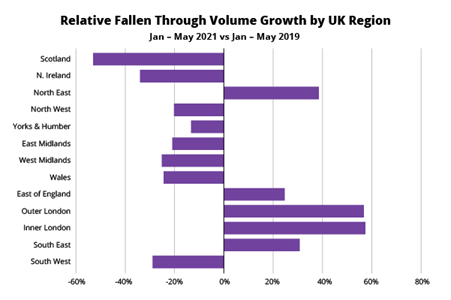
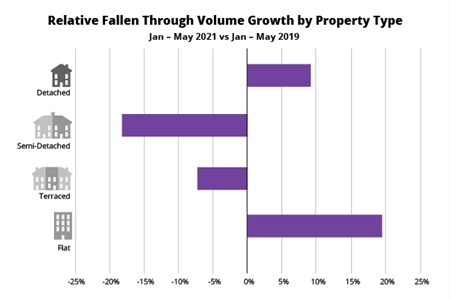
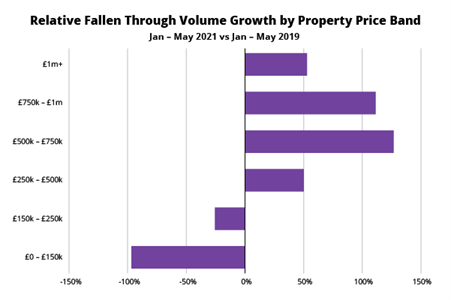
| To explore this a little further, we looked at the distribution of those sales that have fallen through and where they have grown or declined by UK region, property type and price band. In terms ofUK regionfirst of all, this is as follows: |
||||||
 |
||||||
We can observe that there has been a relative increase in the volume of fallen through transactions in London, the North East, the South East, and the East of England as this is also where the bulk of actual transactions occur. In all other regions, the share of fallen throughs have declined, with Scotland’s decline the sharpest of all. In terms ofproperty types, these are shown in the following graphic. |
||||||
 |
||||||
Here we can see that fallen throughs are now more likely to take place with flats and detached properties than in 2019. This may be linked to the recently highlighted cladding safety and compliance issues where sellers cannot provide the necessary paperwork to support mortgage approvals. Finally, in terms ofproperty price bands, these are as follows: |
||||||
 |
||||||
We can see that transactions are more likely to fall through if they involve a property exceeding £250k in value. It is worth pointing out that the scales on this final graph are greater than the previous two. For example, for properties priced between £500k and £1m, the fall through volumes in relative terms have more than doubled in the past two years. |
||||||
| Relative Fallen Through | ||||||
| So now we know that the volume of fallen throughs are 34% higher in 2021 than in 2019, this sounds very drastic, but it (for the time being) ignores the substantial rises in the numbers of sales being agreed. It is a great deal more complex to determine the actual percentage of properties falling through than you might imagine, principally due to the volatility of the denominator. But, without diving into the complexities too far, we track this in three different ways. Each have their own nuances, but all three of these measures have fallen in 2021 from 2019. So, although fallen throughs have increased in volume, we can conclude that if you agreed a sale in 2021, then the chances of that sale falling through at the minute are lower than in 2019. Perhaps the best way of illustrating this is to track a cohort of the same properties….
It will be interesting to see if this situation remains as positive for sellers as we approach the stamp duty holiday expiry at the end of the month. |
15.06.21
Tag Cloud
87
Our latest blog 33
We are open for you over the festive period 2
Albury Drive Pinner - Its going to sell quick 1
1. Finding the right sized home 1
#pinner #property #nationalpress 1
We are always available online too! 1
our latest blog 1
Four ways you could be sabotaging the sale of your home in Pinner 1
Eastcote is now open for Business 1
Great advice when moving home in Pinner 1
Eastcote and Harrow. 1
Trainee sales negotiator required 1
Office Closed for a short time 1
